
What’s the best fabric for summer shirts?
Key findings:#
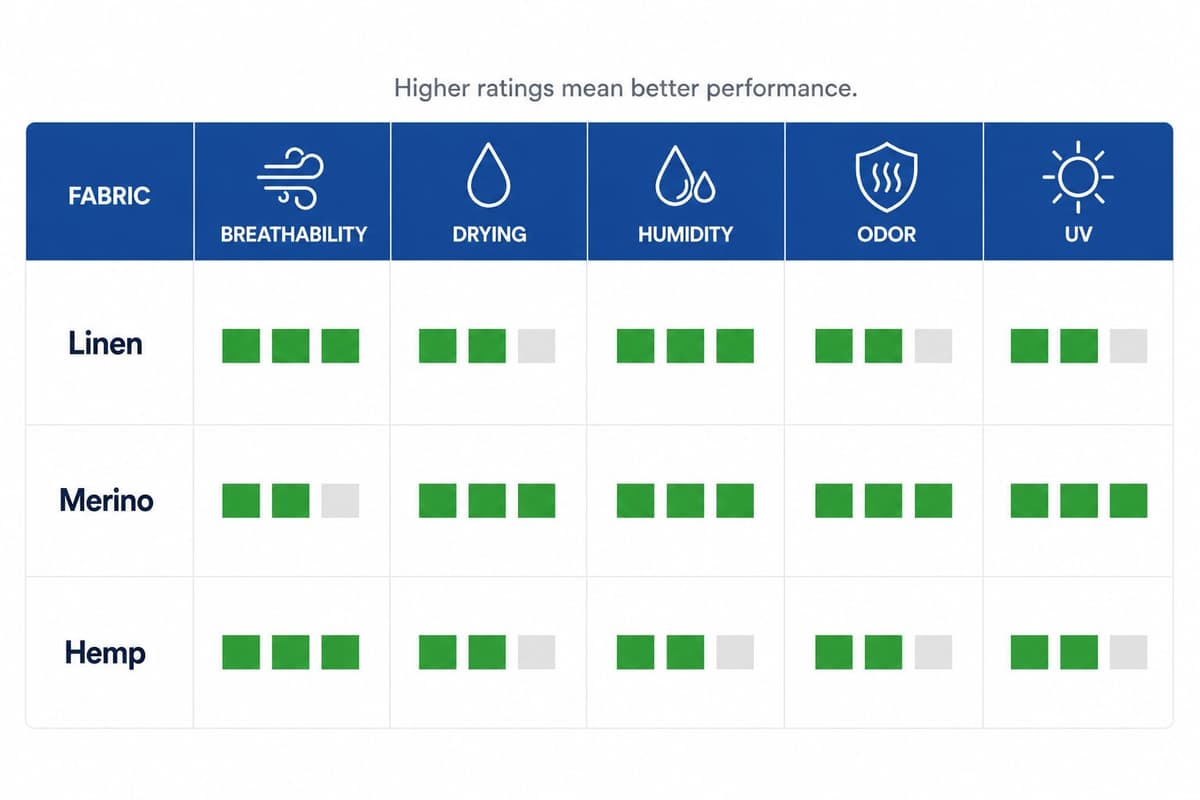
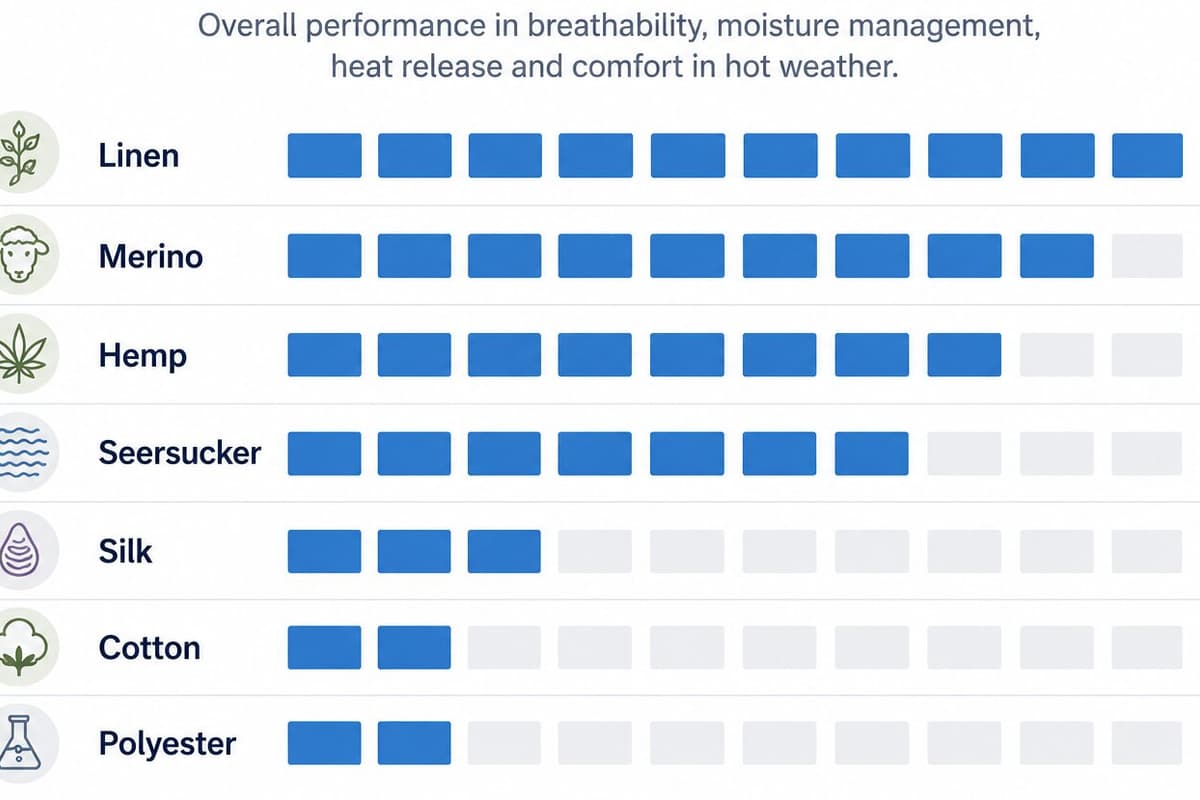
Linen emerged as a strong overall summer fabric due to its breathability, low heat retention, and ability to maintain airflow around the body, making it a multi-factor “win.”
However, merino wool was the most surprising performer, ranking higher for humidity management, odor resistance, softness and overall comfort.
Certain cottons excelled at maintaining airflow and resisting cling in hot weather.
Polyester ranked best in drying speed, but lagged behind other fibers in comfort-related categories.
Flannel and cashmere consistently ranked last due to their insulating properties.
In summertime, your choice of shirt makes the difference between feeling comfortable or spending the day feeling hot and sweaty.
Determining the best summer shirt fabric, however, requires one additional question first. Comfort depends on:
Breathability
Moisture management
Drying speed
Heat release
Resistance to cling
Humidity performance
Odor resistance
UV protection
And airflow
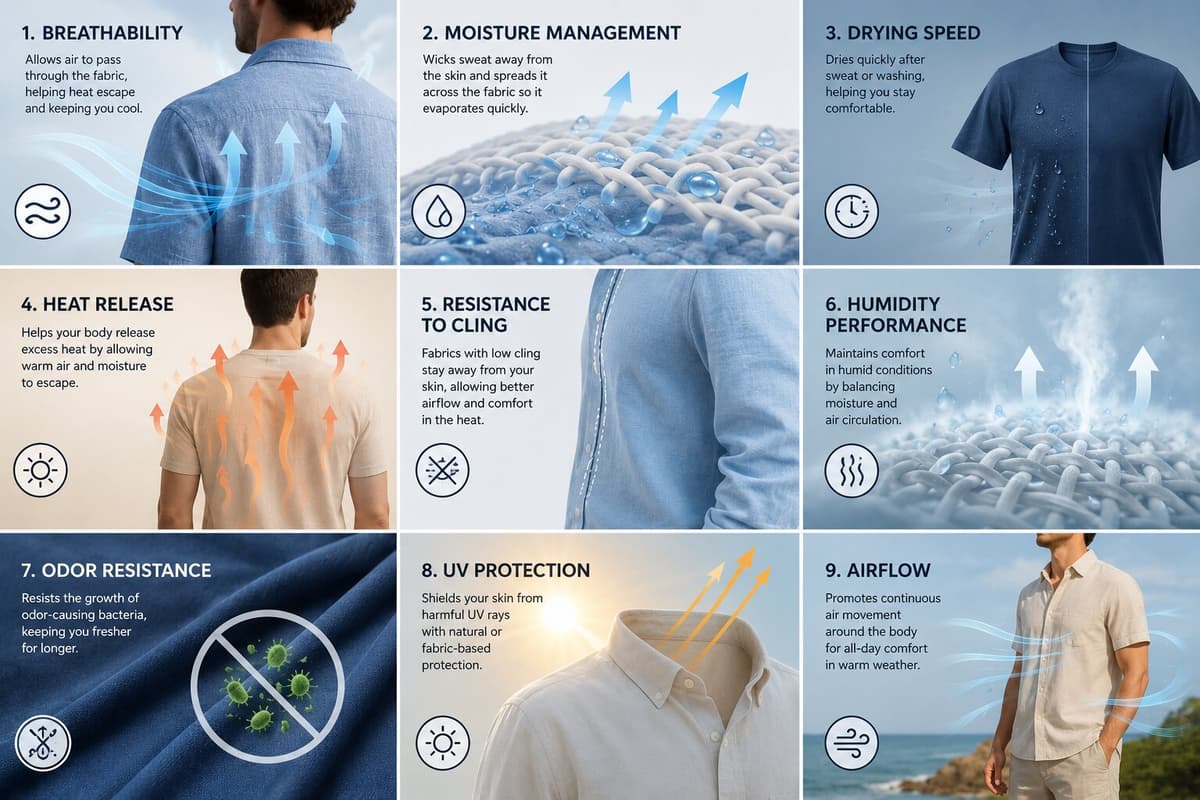
With these specific and measurable factors in mind, Icewear studied the most common shirt materials to provide you with absolute confidence in your choice of shirt materials this summer.
Best summer fabrics for shirts, by category#
Below is the list of the shirt fabrics studied and the top-ranked fabric for each. The list of fabrics was chosen based on what’s most common in designs. You’ll have your own personal priorities in terms of which features (“categories”) are most important to you.
Review this list, but be sure to learn more about the performance of each fabric by category in the Icewear study below.
| Category | Top performer |
|---|---|
| Breathability | Linen |
| Moisture absorption | Hemp |
| Drying speed | Polyester |
| Heat release | Linen |
| Resistance to cling | Seersucker cotton |
| Humidity performance | Merino wool |
| Lightest weight | Silk |
| Air gap retention | Seersucker cotton |
| Odor resistance | Merino wool |
| UV protection | Merino wool |
The fabrics included in Icewear’s study#
Can you name more than four or five fabrics used in summer shirts?
It’s important to review which fabric is which. For starters, some fabrics are made from plant fibers, while others come from animal fibers. Then, some are manufactured using synthetic or semi-synthetic materials. This natural fiber/synthetic fiber divide is one to keep in mind.
The following fabrics are the most common materials you’ll find when shopping for summer shirts.
Cotton#
Cotton is one of the most widely used shirt fabrics in the world. The fiber itself is the same everywhere, but the weave can dramatically influence how cotton shirts perform during summer. That’s where you start to see words like “poplin” or “seersucker” cotton: these names refer to weaves.
The most common summer cotton shirt weaves include:
Poplin: A lightweight and smooth weave commonly used in dress shirts.
Seersucker: A puckered weave that lifts portions of the fabric away from your skin.
Oxford Cloth: A slightly heavier basket weave often used in button-down shirts.
Chambray: A lightweight woven fabric often mistaken for denim.
Voile: An extremely lightweight and airy weave.
Icewear sells 100% cotton articles and cotton blend garments in some collections, but it’s important to know its strengths and weaknesses are. Cotton is a remarkable material and is especially helpful in articles with a specific style or shape, but it can also hold 25 times its weight in moisture, making it extremely uncomfortable in the rain or with heavy transpiration.
Cotton: Summer pros and cons#
| Pros | Cons |
|---|---|
| Widely available | Can absorb and hold moisture |
| Soft and comfortable | Slower drying than many alternatives |
| Breathable in lighter weaves | Might cling when saturated with sweat |
| Available at many price points | Performance varies significantly by weave |
| Easy to care for | Can wrinkle depending on construction |
Linen#
Made from flax fibers, linen has been associated with warm-weather clothing for centuries, and rightly so. Its most popular benefits include exceptional airflow and cooling properties.
Linen: Summer pros and cons#
| Pros | Cons |
|---|---|
| Exceptional breathability | Wrinkles easily |
| Releases heat efficiently | Often more expensive than cotton |
| Resists sticking to skin | Can feel coarse before softening |
| Performs well in humidity | Limited stretch |
| Naturally durable | Requires thoughtful care |
Wool#
Yes, wool.
Usually associated with cold weather, lightweight merino wool is also used in performance apparel and in temperate or warmer climates. That includes summer shirts for time in town as well as using merino wool as a layer during outdoor and summer activities. (Just look at this article about summer sweaters and wool hiking socks.)
Wool’s unique qualities come in part from its fiber structure and “crimp,” or the airy space created between fibers and threads. In an environment like Iceland’s, wool sweaters and other wool-based clothing are especially useful in summer because they can keep you cool (due to their airy breathability) and, when the weather shifts (which it often does in Iceland), then it holds your body’s warmth closer to keep your temperature steady.
Wool’s dual ability to regulate temperature—in cold and in warm climates—is what makes wool one of the most thermoregulatory materials you can find.
Wool: Summer pros and cons#
| Pros | Cons |
|---|---|
| Excellent odor resistance | Can be a bigger investment |
| Performs well in humidity | Heavier than some summer fabrics |
| Naturally temperature regulating | Not all wool is suitable for hot weather |
| Moisture managing | Requires careful laundering |
| Comfortable across a wide temperature range | May feel too warm for some wearers |
Silk#
Silk is a natural fiber known for being lightweight and offering a smooth, luxurious texture historically considered luxurious.
Silk: Summer pros and cons#
| Pros | Cons |
|---|---|
| Extremely lightweight | Less durable than many alternatives |
| Smooth against skin | Can show perspiration |
| Naturally temperature regulating | Often requires delicate care |
| Luxurious feel | Usually carries a premium price |
| Dries relatively quickly | Limited abrasion resistance |
Satin#
Satin is a weave rather than a fiber, and can be produced from silk, polyester, and other materials. It’s a popular material used in other summer clothing like dresses, though you’ll find it in shirts, too.
Satin: Summer pros and cons#
| Pros | Cons |
|---|---|
| Smooth, elegant appearance | Tends to cling when damp |
| Soft against skin | Often traps more heat |
| Drapes well | Lower airflow than other materials |
| Popular for dressier garments | Can show sweat easily |
| Available in many fiber types | Not ideal for extreme heat |
Cashmere#
Cashmere comes from the soft undercoat of cashmere goats and is prized for its softness. But does that mean it’s made for summer?
Cashmere: Summer pros and cons#
| Pros | Cons |
|---|---|
| Exceptionally soft | Retains heat |
| Luxurious feel | Often too insulating for summer |
| Lightweight relative to warmth | Expensive |
| Premium appearance | Requires special care |
| Durable when maintained properly | Limited warm-weather performance |
Hemp#
Hemp has gained popularity as more people seek sustainable natural fibers. Recent changes in legislation around the world have helped open doors for more hemp farming and production, too, which has consistently brought prices down.
Hemp: Summer pros and cons#
| Pros | Cons |
|---|---|
| Excellent moisture absorption | Can feel stiff initially |
| Highly breathable | Less common than cotton |
| Durable and long-lasting | Fewer style options available |
| Sustainable crop | Might wrinkle |
| Performs well in heat and humidity | Often blended with other fibers |
Bamboo viscose#
Bamboo viscose is a regenerated cellulose fiber derived from bamboo pulp. Not sure what that means? You can think of it as another smooth, soft material (instead of something stiff like the plant itself).
Bamboo viscose: Summer pros and cons#
| Pros | Cons |
|---|---|
| Soft and smooth | Durability varies |
| Good moisture management | Can lose shape over time |
| Comfortable against skin | The material is heavily manufactured |
| Breathable | Often slower to dry |
| Popular in performance apparel | Performance varies by manufacturer |
Flannel#
Flannel is a brushed fabric construction usually made from cotton or wool. Though it’s more associated with winter, it’s important to include flannel in a study of summer shirt fabrics since its production does not retain the same pros (or cons) as cotton or wool do individually.
Flannel: Summer pros and cons#
| Pros | Cons |
|---|---|
| Soft and comfortable | Retains significant heat |
| Durable | Limited breathability |
| Cozy feel | Slow drying |
| Popular in cooler weather | Can feel heavy |
| Good insulation | Generally unsuitable for hot weather |
With all the major shirt fabrics now established, continue to learn how each material performs across measurable criteria used in Icewear’s summer fabric study.
The Icewear summer fabric study: Which shirt material is best for summer?#
When people ask for the best summer shirt fabric, they want a simple answer.
Don’t you?
And though there is no one answer, there are absolutely “best shirt fabrics” to be picked once you establish how you’re measuring the “best.”
For example, a fabric that dries quickly might still trap heat. Or a fabric that breathes well may wrinkle easily. Therefore, real summer comfort is the result of several different performance characteristics working together. This study gives you the best, then the best of the best, so you can make the decision that’s right for you based on your criteria.
The ten factors Icewear measured are:
Breathability
Moisture absorption
Drying speed
Heat retention
Fabric-to-skin cling
Humidity performance
Fabric weight
Air gap retention
Odor resistance
UV protection
Next, you’ll see why each characteristic matters, how it’s measured, and how the top shirt fabrics compare when it comes to summer performance.
Breathability#
Why it matters:
Breathability determines how easily air can move through a fabric, and better airflow allows your body heat to escape more effectively.
How it’s measured:
Air permeability measures the amount of air that can pass through a fabric. Higher airflow usually means better cooling potential.
| Rank | Fabric | Air permeability rating |
|---|---|---|
| 1 | Linen | Excellent |
| 2 | Hemp | Excellent |
| 3 | Seersucker cotton | Very good |
| 4 | Lightweight merino wool | Very good |
| 5 | Bamboo viscose | Good |
| 6 | Cotton poplin | Good |
| 7 | Silk | Moderate |
| 8 | Satin | Moderate |
| 9 | Polyester | Fair |
| 10 | Cashmere | Poor |
| 11 | Flannel | Very poor |
Moisture absorption#
Why it matters:
Absorbent fabrics pull perspiration away from the skin and help reduce the sensation of dampness.
How it’s measured:
“Moisture regain” measures how much water vapor each fabric can absorb (relative to its dry weight).
| Rank | Fabric | Moisture regain performance |
|---|---|---|
| 1 | Hemp | Excellent |
| 2 | Linen | Excellent |
| 3 | Merino wool | Very good |
| 4 | Bamboo viscose | Very good |
| 5 | Cotton poplin | Good |
| 6 | Seersucker cotton | Good |
| 7 | Silk | Moderate |
| 8 | Cashmere | Moderate |
| 9 | Flannel | Fair |
| 10 | Polyester | Poor |
| 11 | Satin | Poor |
Drying Speed#
Why it matters:
Once a shirt becomes damp from perspiration or summer rain showers, its drying speed affects how quickly your comfort returns. A wet shirt will cling to you and retain more heat.
How it’s measured:
Drying speed is measured by saturating fabrics and evaluating how quickly they return to their original dry weight.
| Rank | Fabric | Relative drying speed |
|---|---|---|
| 1 | Polyester | Fastest |
| 2 | Merino wool | Very fast |
| 3 | Silk | Fast |
| 4 | Linen | Moderately fast |
| 5 | Hemp | Moderate |
| 6 | Seersucker cotton | Moderate |
| 7 | Cotton poplin | Moderately slow |
| 8 | Bamboo viscose | Slow |
| 9 | Satin | Slower |
| 10 | Cashmere | Very slow |
| 11 | Flannel | Slowest |
Heat retention#
Why it matters:
The less heat a fabric traps, the cooler it feels during warm weather. So, of course, you want a summer fabric to have the lowest possible heat retention.
How it’s measured:
Thermal resistance (which Icewear studied in detail by identifying the “thermal coefficient” of different materials) evaluates how effectively a fabric insulates against heat transfer.
| Rank | Fabric | Thermal performance |
|---|---|---|
| 1 | Linen | Lowest heat retention |
| 2 | Hemp | Very low heat retention |
| 3 | Seersucker cotton | Low heat retention |
| 4 | Cotton poplin | Moderately low |
| 5 | Bamboo viscose | Moderate |
| 6 | Silk | Moderate |
| 7 | Merino wool | Moderately high |
| 8 | Polyester | High |
| 9 | Satin | High |
| 10 | Cashmere | Very high |
| 11 | Flannel | Highest heat retention |
Fabric-to-skin cling#
Why it matters:
A shirt that sticks to your skin feels hotter than one that allows air to circulate around your body.
How it’s measured:
“Cling resistance” is evaluated based on the fabric’s moisture behavior and its drape characteristics (the tendency of wet fabric to collapse against the body).
| Rank | Fabric | Resistance to cling |
|---|---|---|
| 1 | Seersucker cotton | Excellent |
| 2 | Linen | Excellent |
| 3 | Hemp | Very good |
| 4 | Merino wool | Very good |
| 5 | Cotton poplin | Good |
| 6 | Silk | Moderate |
| 7 | Bamboo viscose | Moderate |
| 8 | Polyester | Fair |
| 9 | Satin | Poor |
| 10 | Cashmere | Very poor |
| 11 | Flannel | Very poor |
Humidity performance#
Why it matters:
Many fabrics behave differently in humid environments than they do in dry heat. This is especially important if you live or plan on traveling in places with high humidity levels.
How it’s measured:
Humidity performance evaluates comfort, moisture management and drying behavior under high-moisture conditions.
| Rank | Fabric | Humidity performance |
|---|---|---|
| 1 | Merino wool | Excellent |
| 2 | Linen | Excellent |
| 3 | Hemp | Very good |
| 4 | Seersucker cotton | Very good |
| 5 | Bamboo viscose | Good |
| 6 | Cotton poplin | Good |
| 7 | Silk | Moderate |
| 8 | Polyester | Fair |
| 9 | Satin | Poor |
| 10 | Cashmere | Very poor |
| 11 | Flannel | Very poor |
Fabric weight#
Why it matters:
Lighter fabrics generally place less thermal burden on the wearer. That means you feel less heat in your shoulders where your shirt hangs, and have an increased feeling of airiness between the garment and your skin.
How it’s measured:
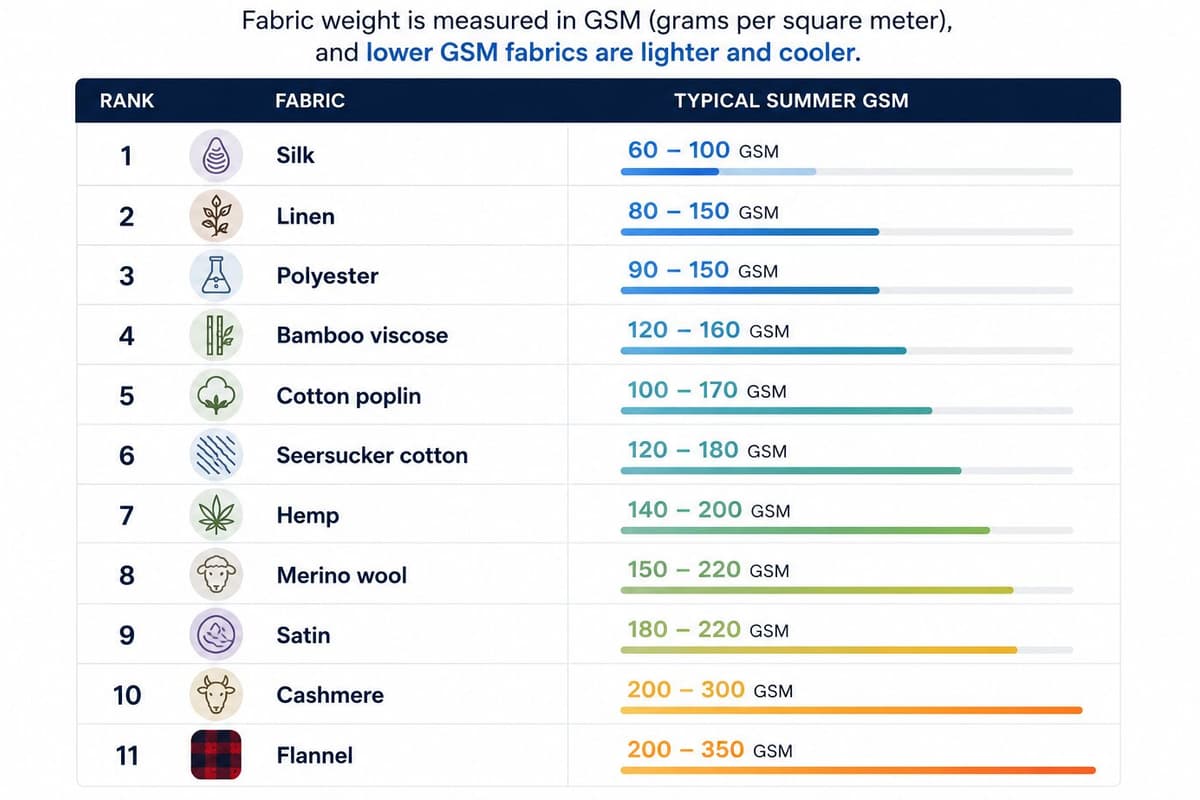
Fabric weight is measured in GSM (grams per square meter), and lower GSM fabrics are lighter and cooler.
| Rank | Fabric | Typical GSM |
|---|---|---|
| 1 | Silk | 60-100 GSM |
| 2 | Linen | 80-150 GSM |
| 3 | Polyester | 90-150 GSM |
| 4 | Bamboo viscose | 120-160 GSM |
| 5 | Cotton poplin | 100-170 GSM |
| 6 | Seersucker cotton | 120-180 GSM |
| 7 | Hemp | 140-200 GSM |
| 8 | Merino wool | 150-220 GSM |
| 9 | Satin | 180-220 GSM |
| 10 | Cashmere | 200-300 GSM |
| 11 | Flannel | 200-350 GSM |
A final note on thickness#
You won’t find an extra table for this factor because it’s relative to each garment, but the thickness of shirt materials has a lot to do with how cool (or warm) it keeps you. Each of the materials in this study might come in different thicknesses, so you’ll want to try things on and take note of how they feel.
Some materials trend on the thinner side, too, which you can see in the weight section above. But, for example, three different cotton shirts might have different thicknesses between them. And a merino wool sweater won’t be as thick as an Icelandic wool one. Ultimately, the thicker the fabric, the more likely it is that it will retain extra heat in the summer.
Air gap retention#
Why it matters:
Fabrics that maintain structure instead of collapsing against your body create natural ventilation channels that you’ll be grateful for come summer.
How it’s measured:
Performance is evaluated by a combination of the fabric’s structure, drape, and ability to maintain space between the fabric and your skin.
| Rank | Fabric | Air gap retention |
|---|---|---|
| 1 | Seersucker cotton | Excellent |
| 2 | Linen | Excellent |
| 3 | Hemp | Very good |
| 4 | Cotton poplin | Good |
| 5 | Merino wool | Good |
| 6 | Polyester | Moderate |
| 7 | Bamboo viscose | Moderate |
| 8 | Silk | Fair |
| 9 | Satin | Poor |
| 10 | Cashmere | Poor |
| 11 | Flannel | Very poor |
Odor resistance#
Why it matters:
Odor resistance becomes increasingly important during hot weather and extended wear. Odors won’t change how warm you feel, but they will absolutely affect your comfort (and everyone else’s).
How it’s measured:
Performance is evaluated based on a combination of moisture management and natural resistance to odor-causing bacteria.
| Rank | Fabric | Odor resistance |
|---|---|---|
| 1 | Merino wool | Excellent |
| 2 | Silk | Very good |
| 3 | Hemp | Very good |
| 4 | Linen | Good |
| 5 | Bamboo viscose | Good |
| 6 | Cotton poplin | Moderate |
| 7 | Seersucker cotton | Moderate |
| 8 | Cashmere | Fair |
| 9 | Flannel | Fair |
| 10 | Polyester | Poor |
| 11 | Satin | Poor |
UV protection#
Why it matters:
Fabrics that block ultraviolet radiation help reduce sun exposure and solar heat gain, too. This is the most forgotten factor when shopping for summer shirts.
How it’s measured:
UPF (Ultraviolet Protection Factor) testing measures how much UV radiation penetrates the fabric.
| Rank | Fabric | UV protection performance |
|---|---|---|
| 1 | Merino wool | Excellent |
| 2 | Hemp | Excellent |
| 3 | Linen | Very good |
| 4 | Polyester | Very good |
| 5 | Cotton poplin | Good |
| 6 | Seersucker cotton | Good |
| 7 | Bamboo viscose | Moderate |
| 8 | Silk | Moderate |
| 9 | Satin | Fair |
| 10 | Cashmere | Fair |
| 11 | Flannel | Fair |
And how about adjustable clothing?#
Once again, you won’t find a table for this factor, because it depends on the design of each article of clothing. But, come summer, adjustable clothing is highly practical for staying cool. If you’re on a hike in 55ºF and you feel comfortable in your favorite pair of hiking pants, that’s great until you reach midday and the temperature climbs to 75ºF. Zip-off pants can make a huge difference in cases like this one. Shirts with zippers or button openings can also give you needed ventilation when the time comes.
Backpacks with a suspended mesh back are also popular in the summer. Jackets with mesh panels over the shoulders are popular for the same reason. And the right items for sun protection, including a hat, sunglasses, and sunscreen, also come into play.
Category winners#
Collectively evaluating all ten categories, several clear leaders emerged in Icewear’s study:
| Category | Winner |
|---|---|
| Breathability | Linen |
| Moisture absorption | Hemp |
| Drying speed | Polyester |
| Heat release | Linen |
| Resistance to cling | Seersucker cotton |
| Humidity performance | Merino wool |
| Lightest fabric | Silk |
| Air gap retention | Seersucker cotton |
| Odor resistance | Merino wool |
| UV protection | Merino wool |
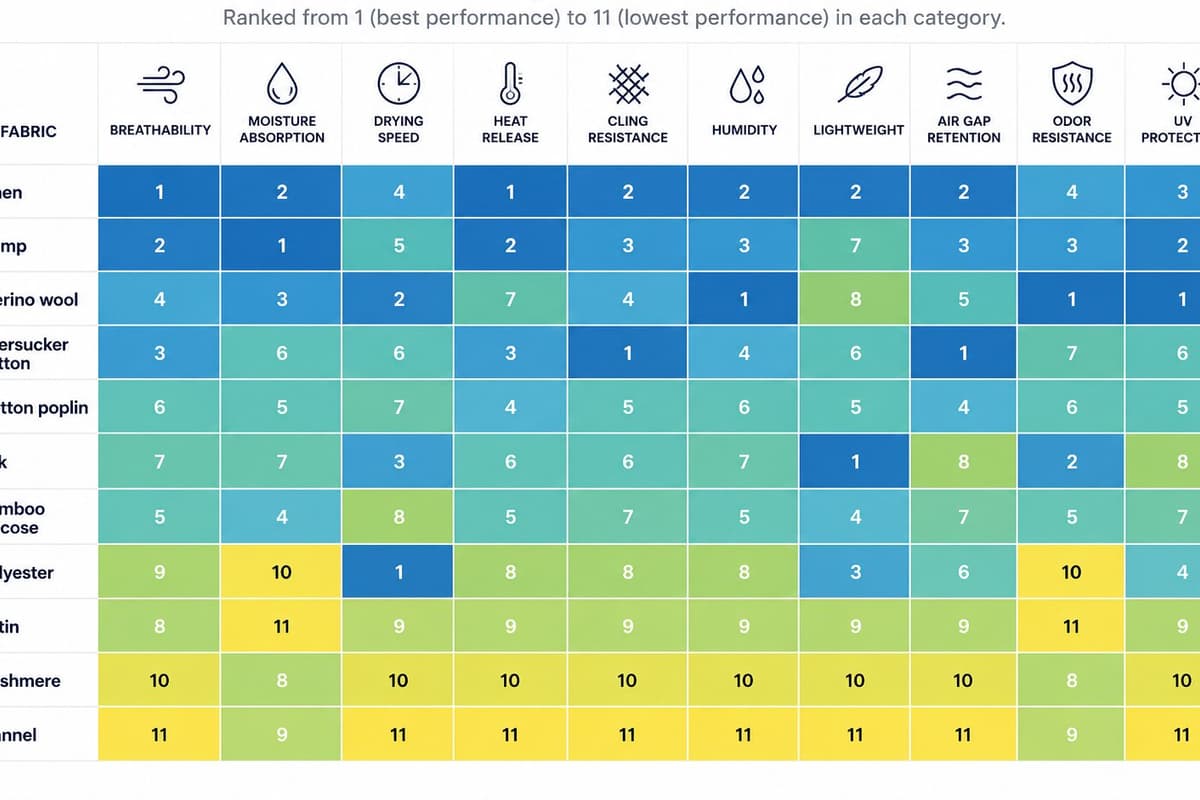
The next step for you is to combine these findings into an overall “best summer fabric” based on the environment you’ll be in and the activities you’ll be doing. Balance moisture absorption and odor resistance for summer hiking, for example. Favor breathability and resistance to cling for nighttime summer outings.
And don’t forget, you can find a huge collection of summer shirts in cotton and merino wool in the Icewear catalog.
Methodology#
To elect the performance factors included in this study as well and to document the performance of each material in those categories, Icewear coordinated with the internal design team after compiling a body of research from various sources.
For each performance factor, Icewear denoted the material rankings based on an average thickness and make-up of each material, due to the fact that individual garments can vary.
Once each material was ranked in each performance category, the composite of factors were ranked as a sum for overall performance, providing a superior look into what fabrics keep wearers cool beyond singular claims limited to one factor.
This approach allowed Icewear to systematically quantify fabric performance and to provide a purpose-driven matrix of factors for wearers to consider when purchasing summer shirts or other warm-weather garments.
More blog posts

Icewear opens new stores in Stykkishólmur and Seyðisfjörður
With new stores open in Stykkishólmur and Seyðisfjörður, you can get the gear you need and the gifts to take the memories home with you.
Read more

Friendship bracelet patterns: 20 cute designs (step-by-step)
Threaded friendship bracelets, also known as string bracelets or friendship bracelets, give you endless pattern options to express yourself and have fun. From beginner to advanced levels, learn all about friendship bracelet patterns here.
Read more

How to make friendship bracelets: Step-by-step beginner guide
Learn how to make friendship bracelets with Icewear’s beginner-friendly guide explaining materials, basic knots, techniques and common mistakes.
Read more