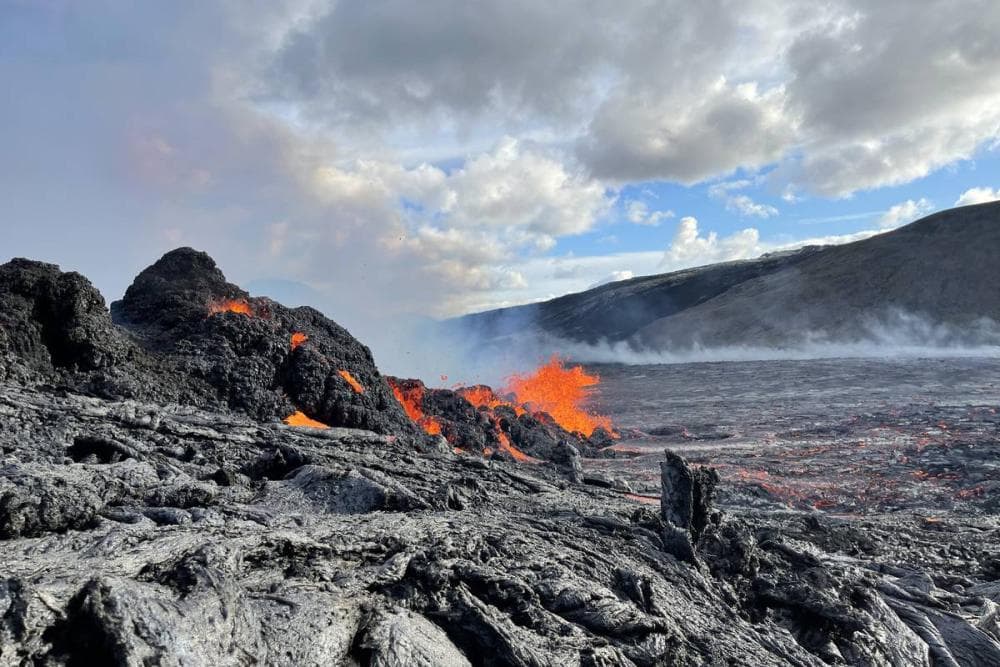
Katla is not erupting now...but this is what to know
On the evening of October 3, 2026, the earth beneath Mýrdalsjökull trembled. Small earthquakes (with a magnitude around 3) were recorded inside Katla, one of Iceland’s more than 130 volcanos.
At the same time, boiling geothermal water bubbled its way into the Múlakvísl river.
Katla’s last major eruption broke through the surrounding glacier in 1918. Before that, the volcano had erupted more than 20 times over the 1,100 years of settlements in Iceland, meaning the average time between eruptions was roughly 50 years.
Now, here we are in 2026, more than a century after the last eruption.
Volcanos don’t own calendars, of course, but the recent quakes and geothermal activity suggest that an eruption might be on its way at the Katla crater.
Recent quakes at Katla#
Katla is a volcanic site in southern Iceland, 170km from Reykjavík (about two and a half hours by car) and not far from Vík, and the small earthquakes in October 2026 were considered typical for an active volcanic system. Sometimes, however, those tremors indicate an impending eruption. Though sometimes, they don’t.
Icelandic volcanic experts say that these early October tremors are not likely a sign for an eruption. But the historic activity of Katla says we’re still probably overdue.
Iceland is a terrain that’s alive both on the surface and underneath. Modern science has become better at listening to what happens underneath, and that’s why more attention has turned to Katla and other active volcanic systems.
For Icelanders and visitors alike, understanding the Icelandic landscape makes Iceland all the more remarkable.
Why Iceland keeps erupting#
Iceland exists because of fire. Sitting on the Mid-Atlantic Ridge (where North America and the Eurasian tectonic plates meet), heat and magma rise from between the two as they rub and pull apart. These forces have slowly produced the island nation we now know as Iceland, and the same forces continue to shape it.
Iceland consists of several distinct volcanic systems. Each system usually includes one central volcano connected by fractures and fissures that magma can travel through. Activity from nearby systems can stress the same fractures, but an eruption or earthquake under one volcano does not mean that magma will flow through tunnels to all the others.
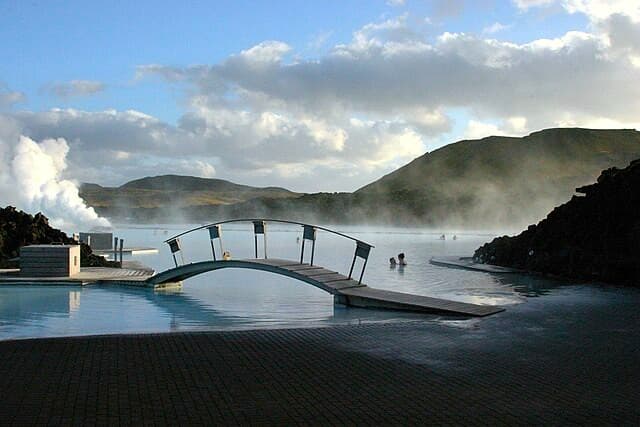
This same system of fractures and fissures explains Iceland’s geothermal activity, too. Rain and snow soak into the ground, then that water flows over and around rock heated by magma. The hot water rises again and carries dissolved minerals and gases with it. This is the source of Iceland’s hot springs, steaming ground, and geothermal pools, plus the geothermal energy that heats homes and swimming pools.
From Eyjafjallajökull to Fagradalsfjall#
Modern Icelandic volcanism (the study of volcanic activity and associated processes) begins with one famous name: Eyjafjallajökull. Its 2010 eruption happened in two parts, and hallmarked the start of today’s most cutting-edge volcano tracking and technology.
See this Icewear reel with the pronuncation of these Icelandic names.


First, on March 20 that year, an eruption began at Fimmvörðuháls in the ice-free pass between Eyjafjallajökull and Katla. The eruption was relatively gentle, but it did produce lava. That eruption ended on April 12.
Two days later, on April 14, an explosive eruption began beneath the ice-filled summit of Eyjafjallajökull. The pressurized magma encountered ice and meltwater, which fragmented it into fine ash. The resulting eruption was explosive and continued for 39 days, ending on May 23, 2010.
The resulting ash cloud disrupted aviation across Europe and made Eyjafjallajökull internationally famous.
Eyjafjallajökull and Katla: neighbors with a curious history#
Katla lies only about 25 kilometers from Eyjafjallajökull. And historically, the two volcanoes have displayed a pattern of activity: eruptions in one are followed by eruptions in the other. Researchers have investigated whether certain changes at one volcano can influence stresses around the other, but the correlation is more nuanced.
For instance, Katla did not erupt after Eyjafjallajökull did in 2010. Does that mean that Katla could erupt at any time now? Or does it mean that the relationship between the two has changed?
What Icelanders and experts learned from the 2010 eruption#
Eyjafjallajökull changed European flight schedules for several weeks, but its lasting impact was a shift in how volcanic activity is tracked.
To predict upcoming eruptions, scientists were already measuring earthquakes, crustal deformation, river discharge and the eruption plume. Seismometers, strain measurements and GPS all helped reveal what was happening underground, while weather radar, satellites, webcams, aircraft observations, lightning detectors and hydrological instruments helped understand what was happening above and around the volcano.
After 2010, however, Iceland became a living laboratory for more integrated volcanic monitoring. What was already being detected under and around volcanoes was finally combined for a holistic look, and new and improved magma tracking was developed alongside better seismic and satellite-analysis algorithms. The resulting study could estimate eruption rates as well as ash fallout with more notice and greater accuracy.
Volcanic monitoring continues to evolve today. In 2026, the Icelandic Meteorological Office (IMO) announced new projects with improved measurement techniques, automatic analysis of eruption plumes, and research into sulphur dioxide hazards for aviation. The IMO was formally designated Iceland’s State Volcano Observatory in the aftermath of Eyjafjallajökull—another lasting change that the eruption sparked.
A volcano still won’t reveal the exact date of its next eruption, but Iceland has showcased what current technology can do to better pick up on the cues.
Then came the “túristagos”#
In March 2021, Iceland experienced a new kind of eruption. A fissure opened near Fagradalsfjall on the Reykjanes Peninsula after weeks of seismic activity. Lava began oozing into an uninhabited valley.

The eruption was close enough to Reykjavík for residents (and tourists) to reach on a day trip, and it was an eruption with many safe viewing points and no towns in its path. Subsequently, thousands of people hiked across the peninsula to watch fresh lava being made. Today, sometimes jokingly, this tourist-accessible kind of eruption is described in Icelandic as a “túristagos” (literally, a “tourist eruption”).
Of course, that doesn’t mean the eruption is completely harmless. Volcanic gases, rapidly changing weather, difficult terrain and fresh lava all remain dangerous. But compared with an explosive eruption beneath an ice cap, Fagradalsfjall offered something extraordinarily rare: an eruption that, under official guidance, you can witness in person.
Ongoing activity at Fagradalsfjall#
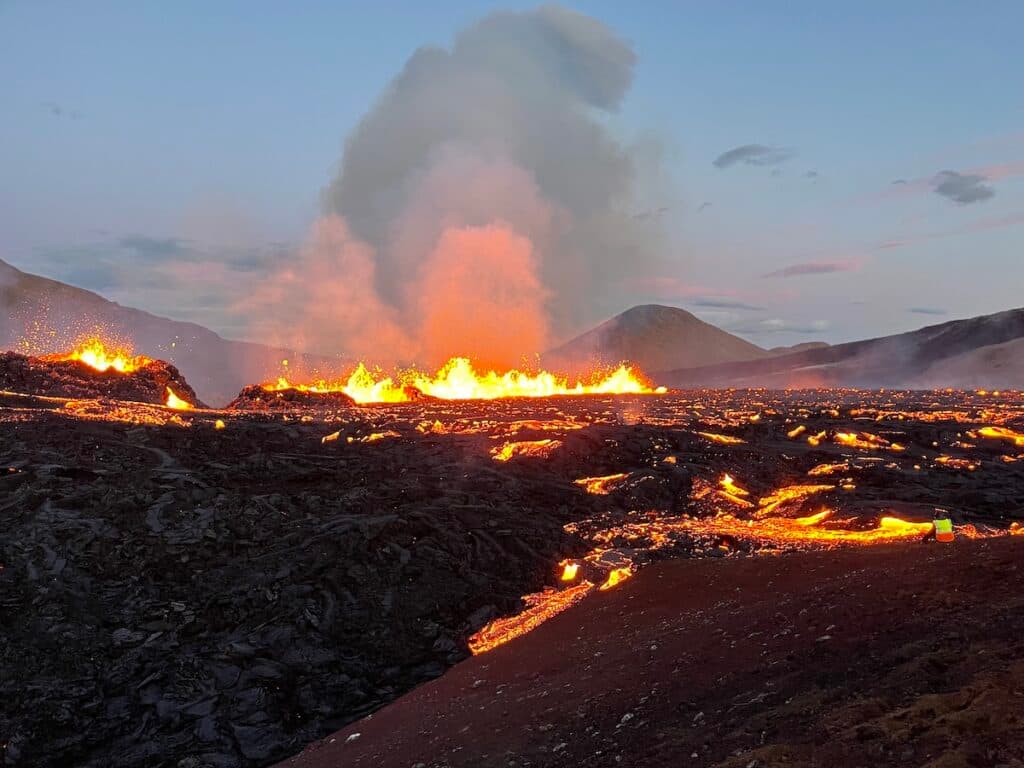
During the 2021 event, activity shifted among vents and craters as magma exploited different pathways to the surface. Then, new eruptions occurred in the wider Fagradalsfjall area in 2022 and again in 2023. The Reykjanes volcanic episode subsequently shifted farther west toward Grindavík and the Sundhnúkur crater row.


So, where could Iceland erupt next?#
There is no science that can tell us without fail which Icelandic volcano will erupt next. But these two famous volcanoes in South Iceland deserve attention (and for very different reasons).
Katla: a giant beneath the ice#
Katla is mostly hidden beneath Mýrdalsjökull (an icecap), both situated about 170kms from Reykjavík. That layer of ice is one reason an eruption here would be different from the spectacles that visitors have seen on the Reykjanes Peninsula.
When magma erupts beneath thick ice, enormous quantities of meltwater can be produced. Contact between magma and water can also create violent fragmentation and ashy, explosive activity. Historically, Katla’s eruptions have generated both ash plumes and immense “jökulhlaups” (glacial outburst floods).
To understand why those floods matter:
On July 9, 2011, a jökulhlaup emerged from Mýrdalsjökull and swept away a bridge on Iceland’s Ring Road. In some places, the river rose by more than 17 feet in less than an hour.
And now, new reports show small earthquakes under Katla, as recently as October 2026. Are these a guarantee that Katla is about to erupt? No. Are they worth watching, though? Absolutely.


Hekla: the volcano giving little warning#
The Hekla volcano, located about 150km from Reykjavík, can develop an eruption notoriously fast. Its last one was in 2000, with four other eruptions spread out through the 20th century. There were so many eruptions between 1900 and 2000, in fact, that Icelanders and scientists have started to wonder if this crater, too, is overdue.
More remarkably, some of Hekla’s eruption signals only appear within an hour (or less) before an eruption begins. That makes Hekla a different proposition for hikers, in particular, with special equipment and safety concerns to keep in mind.
Hiking in volcanic Iceland#
Watching an eruption could be one of the most extraordinary experiences of a lifetime. But Icelandic nature rewards preparation more than guts.
The obvious danger during an eruption is lava. The less obvious dangers include:
Ash
Poor visibility
Toxic volcanic gases
Sudden weather changes
Unstable new lava
Earthquakes
Glacial floods
A jökulhlaup, in particular, can transform a river with startling speed. And then, there’s Icelandic weather in general. Even a route that’s marked with signage (or “stikkað” poles) could become difficult to follow with sudden mist reducing visibility.
Basic safety when hiking volcanoes#
Operators on guided volcanic hikes generally have an active safety plan and continuously monitor national warnings, weather, gas and seismic information. Tourism companies operating at eruption areas are also required to maintain safety plans and follow instructions from police and rescue authorities.
A practical standard for travelers to look for is a guide who can receive frequent live updates on a phone or GPS-connected device.
If you hike independently, preparation becomes your responsibility:
Tell somebody exactly where you are going and when you expect to get back
Check the Icelandic Met Office and SafeTravel before leaving and as conditions change
Carry a charged phone and, for remote routes, appropriate GPS and communications
Carry food, water and enough insulation to survive unexpected delays
Consider emergency shelter or a bivouac bag in case weather deteriorates
Never assume that because other tourists are walking somewhere, it’s safe

Volcanic rescue volunteers#
One of the remarkable institutions behind Icelandic outdoor life is the Icelandic Association for Search and Rescue, known in Icelandic as “Landsbjörg.” It’s a non-profit, volunteer-based organization with more than 4,500 volunteers who provide search and rescue assistance around the country, day and night, throughout the year. SafeTravel is operated by ICE-SAR.
Much of the group’s capability depends upon fundraising, donations and sponsorship.
Should Katla or Hekla change your plans for Iceland?#
Generally, no. They should change how you prepare for Iceland, though. In a world where you can’t control volcanic forces, you can choose gear wisely. That’s where you do have the choice.
In terms of likely eruptions, Katla is capable of explosive activity, heavy ashfall and enormous glacial floods. Hekla, on the other hand, has demonstrated exceptionally short eruption warnings. Reykjanes has shown since 2021 that magma can repeatedly find new routes through a volcanic landscape. And the 2010 Eyjafjallajökull eruption demonstrated that a relatively modest Icelandic volcano can disrupt life thousands of miles away.
That unpredictability is part of what makes Iceland extraordinary.
If you visit Iceland, you can stand—with no shortage of awe—on one of the few places on Earth where the land under your feet is still visibly in the process of creation. Icewear is where you can prepare for the factors that are within your control:
More blog posts

Icewear opens new stores in Stykkishólmur and Seyðisfjörður
With new stores open in Stykkishólmur and Seyðisfjörður, you can get the gear you need and the gifts to take the memories home with you.
Read more

Friendship bracelet patterns: 20 cute designs (step-by-step)
Threaded friendship bracelets, also known as string bracelets or friendship bracelets, give you endless pattern options to express yourself and have fun. From beginner to advanced levels, learn all about friendship bracelet patterns here.
Read more

How to make friendship bracelets: Step-by-step beginner guide
Learn how to make friendship bracelets with Icewear’s beginner-friendly guide explaining materials, basic knots, techniques and common mistakes.
Read more